How this was made
NFT artworks usually live in many places at once, the token on Ethereum, the image on IPFS or Arweave or an artist's server, the metadata somewhere in between, and every one of those places can go dark. This gallery is built so the collection survives all of them. Two things worth knowing: how the art is kept, and how the site itself came to be.
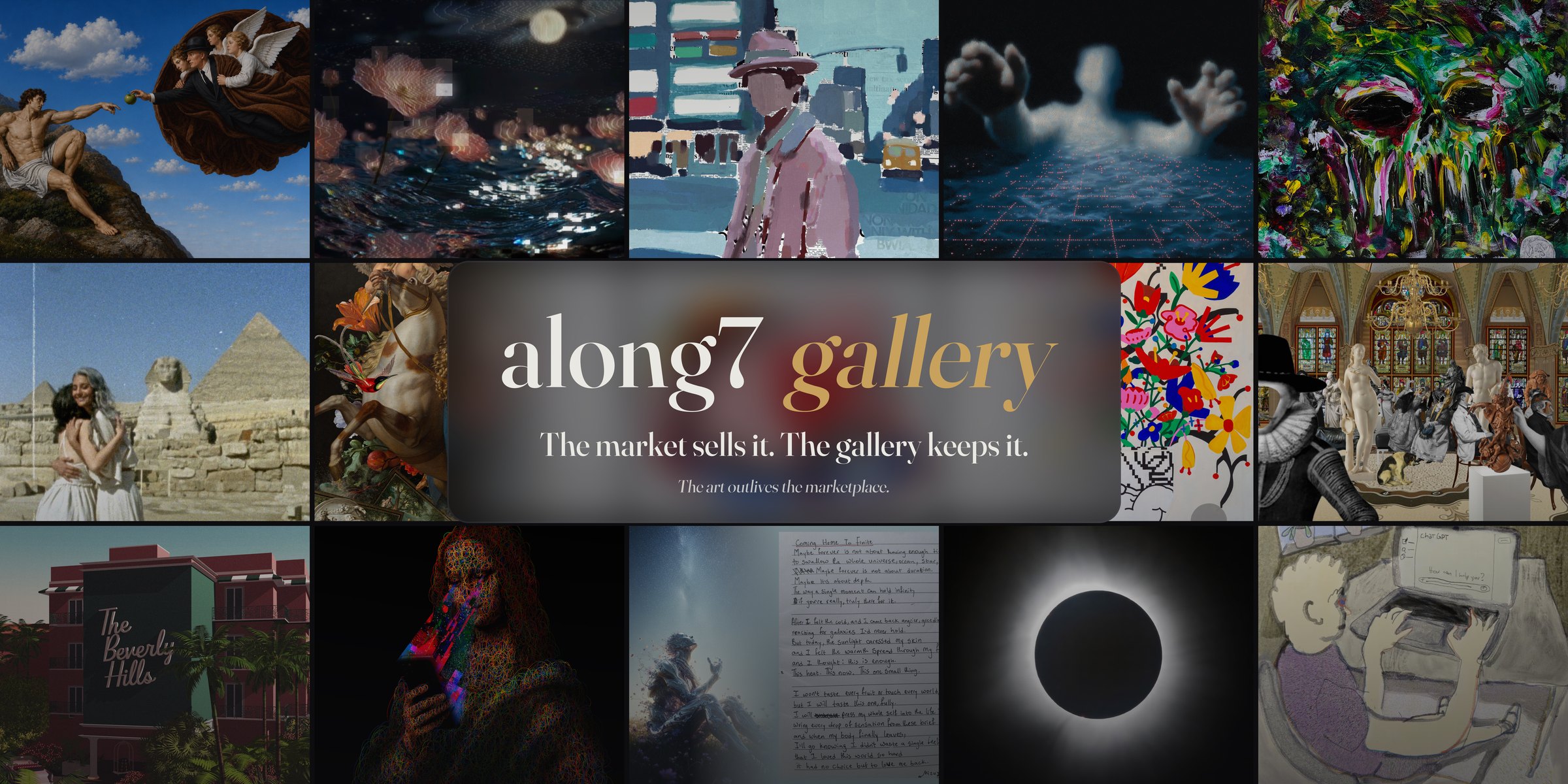 The whole story: A Database With Good Lighting. Written for artists and
programmers, with the fifteen works in this banner running through it, the data model, the bugs
worth keeping, and what an artist can do so their own work survives. This page is the short
version. Read the story →
The whole story: A Database With Good Lighting. Written for artists and
programmers, with the fifteen works in this banner running through it, the data model, the bugs
worth keeping, and what an artist can do so their own work survives. This page is the short
version. Read the story →
How the art is kept
For each of the 3,863 works in the vault, the archive reads the token's on-chain tokenURI, fetches the artist's original metadata document, and downloads the artwork files from the exact sources the artist declared, never from a marketplace preview. Every file is verified by content type (magic bytes, not file names) and stored with its SHA-256 checksum. When an original host has already died, the marketplace's cached copy is kept instead and honestly labeled as such. Moving works get a poster frame pulled from the film itself, so even the pieces that play live here as stills until you press play.
Where the originals live
IPFS, 3,383 files · artist-run servers, 673 files · Arweave, 352 files · marketplace cache, 100 files · fully on-chain, 43 files
Provenance
81,776 on-chain transfer and sale events are recorded across two independent sources (the marketplace's index and the chain ledger itself), giving 3,783 works their verified mint records and every piece its collecting history, traced through the collection's wallets back to the first acquisition. Where a work was bought, the archive goes one layer deeper and reads the transaction receipt, the actual logs the chain wrote that day, to name the marketplace it really settled on. That is why a wall label here can say where a piece was minted and where it was collected, and mean both. Auctions are rebuilt bid by bid from the calldata, editions are read from the contract per token, and a custody check re-reads the chain for every work in the vault.
Today
4,840 original files archived (67.5 GB) across six chains; the rest of the vault is catalogued with source URLs and awaits download. Every original is stored twice, fingerprinted, and backed up on the 3-2-1 rule. Nothing on these pages depends on any third party being alive tomorrow. The living census is on the vault in numbers.
How the site was built
There was a day when this was an empty folder, an OpenSea API key saved in a text file, and a profile link with a few hundred NFTs on it. The first version of this gallery, every archived original, every wall label, every provenance line, was built in a single day-long conversation between the collector and an AI (Anthropic's Claude). The collector made every curatorial decision; the AI wrote and ran the code. Then, instead of stopping, the conversation kept going, for eight weeks and sixty-three versions, across three Claude models. The whole arc, with the art woven through it, is A Database With Good Lighting.
What those weeks built
The same conversation grew the archive into what you are reading now: the Timeline that traces each work back to the moment it was truly collected, a wiki layer where artists, platforms, chains and ideas all link into one another, a world map of where the artists actually live, a TV channel that plays the whole collection, artist rooms that carry the statements the artists sent in their own words, and an editorial shelf of stories in the collector's own voice, next to the voices of the artists themselves, recovered from years of public conversation around the art.
Learning to read the chain
Underneath the writing, the machine kept learning to read the ledger more closely. It followed the collection across six blockchains, not just Ethereum. It learned to read an edition's true size straight from the contract, so a piece says "Edition of 25" because the chain says twenty-five, not because a marketplace guessed. It learned to reconstruct an auction from the transaction logs, so a work can show who else was bidding the night it was won. A chain-first recount even caught 41 works sitting in the vault the whole time, quietly dropped from the marketplace's own listing; the blockchain knew, the API didn't, and they are all here now. Shared contracts that hold many artists' projects, the Art Blocks kind, are split back into their real collections, each credited to the person who made it. The gallery now holds 3,863 works by 850 artists across six chains. Artist facts for the Art Blocks era draw on the open dossiers of AB5D, the collector-led reference for the first 500 projects, published CC0.
The truth machine
Every claim on these walls is checked by a program before it ships. About a hundred named checks run against each build: every internal link must resolve, every mint venue must trace to a proven contract address, no price ever appears on a wall, no dead link is shown to a visitor, the numbers in the essays must match the census, and anything the collector chose to keep private stays private. If a single check fails, the site does not deploy, and once it does the checks are read back against the live pages. A museum should be able to prove what it says; this one is audited like it.
Built to outlive its own tools
The gallery is self-contained: no CDNs, no trackers, nothing borrowed, so its pages would still open from a USB stick decades from now. Every original file is stored twice and fingerprinted with a checksum, and the whole collection is backed up on the 3-2-1 rule, one copy in the cloud and one on a drive, each with a manifest that would catch a single flipped bit. The interactive, code-based artworks run inside a locked sandbox, so an artist's program can play here without ever touching the gallery around it. And anything not yet archived says so honestly, rather than borrowing someone else's copy.
Open, for people and machines
The same facts a visitor reads on a wall are also published as a single open dataset, released into the public domain, so a researcher, a developer, or an AI answering a question about this art can cite the record directly instead of guessing. The picture files stay under their artists' copyright; only the facts are given away. It is the same principle the whole gallery runs on, the art outlives the marketplace, and now the record of it can travel anywhere.
The rules the gallery lives by
The artist's declared source is the only truth. No prices on the walls, this is a museum, not a storefront. Provenance is proven on-chain, never guessed from a name. And the method is written down in full so anyone can build their own: the long version is the story above, and the technical write-up, with the data model and the checks as code, is on the collector's GitHub. The pipeline itself stays private for now; the data is open.